


As the Council on Competitiveness and its members, partners, sponsors and affiliates begin working together on the Exploring Innovation Frontiers Initiative (EIFI), reflecting on what has changed across the innovation landscape since, as a nation, we collectively established national priorities for innovation are critical. A decade has passed since the release of the Council’s cornerstone publication, Innovate America, and National Academies Rising Above the Gathering Storm, and the authorization of the first bipartisan America COMPETES Act—which has its foundation in the Council’s National Innovation Initiative. In a sense, these efforts have set the overarching path for science, technology and innovation policy in the United States since the mid-2000s. Yet, the context for innovation in the second decade of the 21st century has changed; the ground has shifted beneath our feet. Models of innovation have continued to evolve, and the environment for American innovation presents new challenges—and also new opportunities.
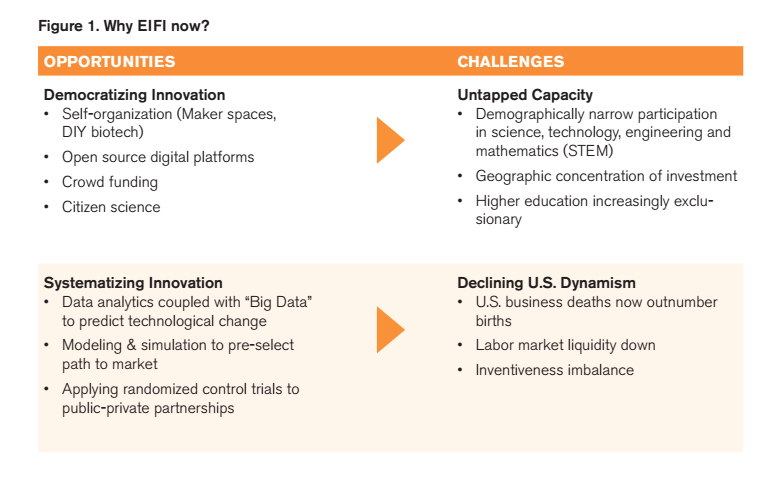
Opportunity – Democratizing Innovation
In the early 2000s, the open innovation movement emerged in response to the transformation of the global industrial landscape that began in the 1980s. Vertically integrated corporations shed business units (particularly manufacturing) to focus on their core competencies, and shifted research and development (R&D) away from basic research and towards the near-term needs of their respective business units. This ushered in an era in which foundational, technological breakthroughs were as likely to come from universities, national laboratories, and small start-up companies. Thus, businesses today increasingly look as much externally as internally for sources of invention and innovation.
In addition to the ever more outward focus of private sector innovators, the Great Recession of the late 2000s has created new pressures both on academia and legislators. The expectation that universities and community colleges will be active centers for economic development has heightened, and public expenditures on R&D are increasingly justifiable only if they directly boost the economy and create jobs in the near term. As such, the last decade has witnessed the creation by innovation stakeholders of quasi-public institutions (proof-of-concept centers, technology demonstration facilities, innovation hubs, etc.) to bridge the gaps in the innovation ecosystem—be they financial, institutional, or behavioral— widened by the open innovation movement.
Bridging institutions like these, nonetheless, are firmly rooted in Vannevar Bush’s 20th century vision of the U.S. STI enterprise. While this model remains the global standard for national systems of innovation, transformational models rooted in the democratization and self-organization of innovation are beginning to emerge across the nation. For example, doctoral students—enabled by the plummeting cost of synthesizing and decoding DNA, by the develop-ment of relatively inexpensive tools such as centrifuges, and by the proliferation of crowdfunding platforms—are dropping out of big-budget academic institutions and corporate R&D departments to build their own labs in urban centers across the country.
Manufacturing innovation is following a similar path (i.e. maker spaces)—a path that is now well-worn by the information and communication technology (ICT) community and its “hobbyists” that launched the personal computing revolution in garages across America. ICT—specifically the shrinking, ever cheaper, more powerful and cloud enabled computing tools—in fact underpins the revolutionary changes in fields such as biotechnology and manufacturing. 3-D printers, inexpensive reactors and microfinance websites are what is emerging on the surface.
Less obvious than these surface trends is a fundamental change in how people think about and pursue innovation. It is now possible for someone to imagine, develop and scale a disruptive technology independent of traditional institutions of innovation. The linkages between production and capital are increasing, expanding the financial options well beyond traditional sources. Innovation in one field, sector, or discipline increases the pace of innovation in another. The stage is set for exponential innovation, and we must optimize our nation for this new, unfolding reality.
Challenge – Untapped Innovation Capacity
While we may be experiencing a historical proliferation of democratic models of innovation, it is unwise to conclude that the traditional national system of innovation is not critically important to our nation’s well being. Moreover, leading experts in science, technology, and innovation policy are concerned that the innovation ecosystem is increasingly characterized as exclusionary—as evidenced by concerning trends in demography, higher education, and risk capital.
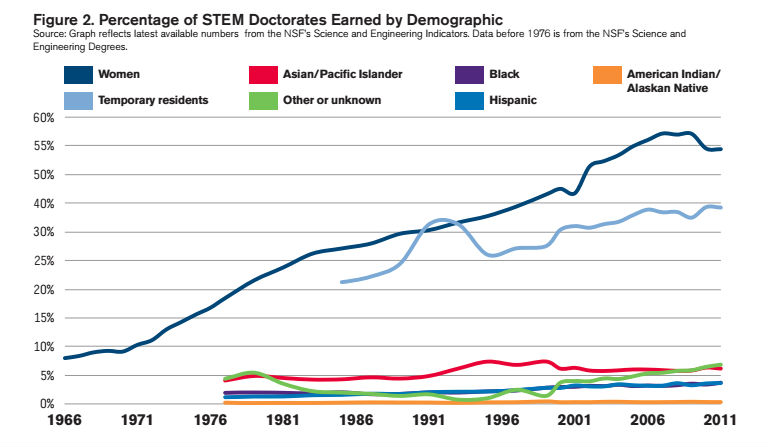
Historically, women and people of color have been underrepresented in the U.S. innovation ecosystem. Figure 2 highlights the dismal state of STEM diversity in academia at the middle of the 20th Century—when neither women nor minority groups (individually) could claim more than a seven percent stake in the academic community. Fortunately, after the expenditure of much time, money, and political effort, science and engineering education has become much more open and diverse over the past half century—particularly for women and temporary residents. Figure 2 reveals that, today, women are represented roughly proportional to their representation in the U.S. population and the STEM disciplines have benefited from high-skill immigration. Unfortunately, little or no progress has been made to broaden the participation of native-born minority groups.
One might suggest that the United States has gotten along quite well with the status quo—as pertains to underrepresented minorities—and, as such, can continue to do so with little risk. However, demographic data suggests otherwise. Census projections reveal that the country’s non-Hispanic population will peak at 200 million in 2024, while the multiracial population is projected to more than triple by 2060. As a result, whites will be in the minority by 20431. Thus, the U.S. innovation ecosystem is out of step with our shifting demographics. The communities in the United States that will soon represent the majority of the U.S. population are the same communities that remain disconnected from the innovation ecosystem.
Not only is the relative size of the pool of potential innovators shrinking, it is becoming increasingly difficult for these college applicants to access the crown jewels of the U.S. innovation ecosystem— research-grade universities. These institutions are the primary source of knowledge creation and technological innovation that drive American productivity, competitiveness, and prosperity. Yet, the student population at these universities represents a disproportionately small number of U.S. undergraduates. While there is no formal taxonomy for the nation’s top-tier research universities, using proxies such membership in the American Association of Universities and U.S. News & World Report rankings, the president of the University of Arizona and Council on Competitiveness vice chair, Michael Crow, has estimated that roughly 1 in 10 undergraduates are currently enrolled in first-tier public and private research institutes2. This comes at time when demand for college enrollment is increasing and acceptance rates are falling at research-grade institutions, which will continue to drive down this ratio. For example, between 1989 and 2013 the ratio of freshmen applicants to admitted students at the University of California, Berkeley declined from 40 percent to 16.35 percent3. Certainly, the “Ivies” are following this trend and more and more state research universities are following suit.
Finally, there remains a long-standing concentration of innovation investment—venture capital, public research and development spending, etc.—in well-established centers of innovation excellence. While there has been an expansion of venture capital into more regions of the country, according to the most recent MoneyTree™ Report by PricewaterhouseCoopers LLP and the National Ven¬ture Capital Association, the majority—approximately 65 percent—of venture capital investment remains in just three regions: Silicon Valley, Boston, and New York4. Moreover, according the latest National Science Foundation Survey of Federal Funds for Research and Development, over half of the nation’s public R&D expenditures are concentrated in just eight states—which, not surprisingly, include California, Massachusetts, and New York5. The United States cannot expect to sustain its leadership in innovation when the share of its population that have the opportunities and resources to engage in the innovation process continues to shrink.
Opportunity – Systematizing Innovation
At the same time we have witnessed an increasing awareness of, attention to, and democratization of the innovation process, the development of new methodologies and tools have driven a proliferation of inquiries into the science of the innovation process itself. These efforts have largely focused on reducing the risk and uncertainty in the innovation process through the application of novel technologies, or the novel application of science and technology to innovation management.
Researchers are using the ever-expanding availability of large data sets coupled with data analysis tools to predict technological change, which could provide enormous competitive advantages to organizations that perfect this technology. R&D managers in corporate laboratories, large and small, are using advanced modeling and simulation tools to select innovation pathways with the highest likelihood of success—while avoiding unsuccessful and expensive trials that do not bear fruit. Universities are experimenting with open source software platforms to improve and drive down research infrastructure costs. University campuses are also test beds helping to create the “Internet of Things”. For example, the University of California, San Diego recently began developing its Integrated Digital Infrastructure that will connect all university research equipment to a digital platform and data repository allowing researchers dynamically to generate, analyze and communicate data6. Whether in a corporate laboratory or on a university campus, the overarching trend here is the infusion of computing into every stage of the innovation process. For individuals and organizations that can harness these new capabilities, the benefits and opportunities are practically boundless.
Researchers are also beginning—in earnest—to apply the scientific method to stages in the innovation process, such as randomized controlled trials (RCTs) targeting bridging institutions (innovation hubs, proof of concept centers, demonstration facilities, university-industry partnerships, etc.). Academics have been contributing for decades to the field of corporate management and just now beginning to focus their attention on these new types of organizational structures—which are the newest tool to accelerate and optimize technology commercialization.
Challenge – Declining U.S. Dynamism
Revving up the U.S. innovation engine does not, per se, translate into American prosperity. Innovation needs to be diffused and scaled in the United States to ensure the economic impact is as far-reaching as possible. This is an active, not passive process undertaken by businesses and people. It is dynamic, inherently disruptive—both destroying and creating new markets, jobs, and opportunities—and lies at the core of American economic and national security. Historically, innovation has been a net positive for the United States, evidenced by a steadily rising standard of living for Americans over the last century. In fact, this is the foundational premise upon which the Council on Competitiveness was built—productivity gains, through innovation, drive up wages. There is, however, a mechanism built into the productivity-prosperity relationship. External forces such as technological disruption change the make-up of the economy by eliminating and replacing low-skill, low-productivity jobs with higher-skill, higher-productivity work. In order for the nation to realize aggregate productivity gains and rising wages, workers need to transition from less productive work to newly created, more productive opportunities. However, there is evidence that, in recent years, innovation has been more destructive than disruptive.
In 2008, for the first time in 35 years, U.S. business deaths outnumbered births. While there has been a slight uptick in start-up activities, the overall trend is clear—firm creation has been on the decline since the 1970s7. If new firms are not established, workers are likely to remain locked up in their previous jobs or go on unemployment because there aren’t new, higher productivity jobs to which they can be relocated. Data on labor market liquidity confirms this trend. Worker reallocation and churn rate have declined since 20008. Thus, the coveted new economy jobs are slow to arrive—if they arrive at all—and workers are staying put or dropping out of the workforce.
Moreover, the worker reallocation that is occurring is trending in the wrong direction. The manufacturing sector is a poignant and illustrative example. Millions of well-paying low- and middle-skill manufacturing jobs have been lost since 2000. While productivity-enhancing technologies are not the only cause of this job loss, together with international competition, they play a primary role. There has not been, however, a commensurate rise in advanced manufacturing jobs. Figure 3 reveals that between 2000 and 2013, the manufacturing sector lost 5.39 million low- and middle-skill manufacturing jobs. Over that same period, the sector added just 280,000 manufacturing jobs that required at least a college education. So, what has happened to all the manufacturing workers? Largely, they have filled the ranks of low-skill service sector workforce.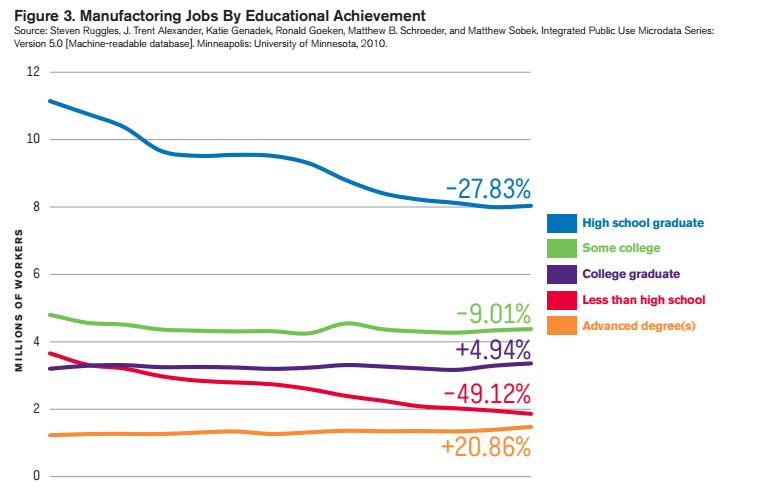
A recent National Employment Law Project data brief exploring job growth since the 2001 recession, finds that—over the last decade—job growth has been consistently dominated by low-wage service-providing industries, middle skill jobs are disappearing, and high-skill job growth is anemic9. This scenario describes how a large portion of our country has, as a result of technological change, been pushed down the socioeconomic ladder. For many Americans, accelerating innovation has yet not translated to more and better opportunities. On the contrary, it is feeding several difficult trends facing our nation: wage stagnation, income inequality, bifurcation of the workforce, and social distrust. All of these trends, independently, threaten are ability to innovate either directly or indirectly. And, taken together, structural changes tarnish the public opinion of technological innovation in a way that reducing the mandate of policymakers to invest in science, technology, and innovation.
1. United States Census Bureau, “U.S. Census Bureau Projections Show a Slower Growing, Older, More Diverse Nation a Half Century from Now”, December 12, 2012. Accessed June 1, 2015. https://www.census.gov/newsroom/releases/archives/population/cb12-243.html
2. Michael M. Crow and William B. Debars, “A New Model for the American Research University.” Issues in Science and Technology, Volume XXXI, Issue 3, Spring 2015.
3. Ibid.
4. National Venture Capital Association, “U.S. Venture Capital Investment Spanned 160 Cities in 2014”, January 20, 2015. Accessed June 1, 2015. http://nvca.org/pressreleases/u-s-venture-capital-investment-spanned-160-cities-2014/
5. National Science Foundation, “Federal Funds for Research and Development FYs 2012-2014”, Detailed Statistical Table, NSF 14-316, September 30, 2014.
6. The University of California, San Diego, “Integrated Digital Infrastructure (IDI)”, Accessed June 1, 2015. http://idi.ucsd.edu/
7. U.S. Census Bureau, Business Dynamics Statistics.
8. Steven J. Davis and John Haltiwanger, “Labor Market Fluidity and Economic Performance”, National Bureau of Economic Research, September 2014.
9. The National Employment Law Project, “The Low-Wage Recovery: Industry Employment and Wages Four Years into the Recovery”, Data Brief April 2014.